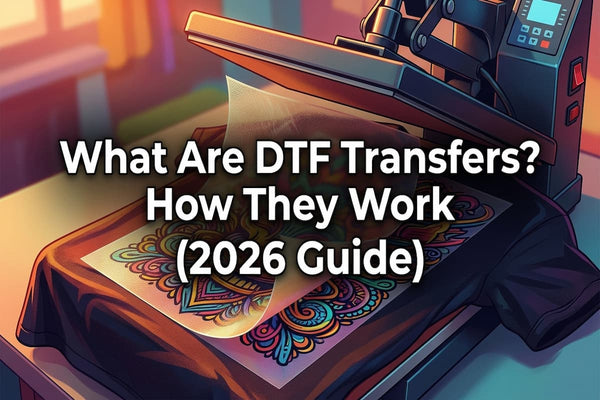
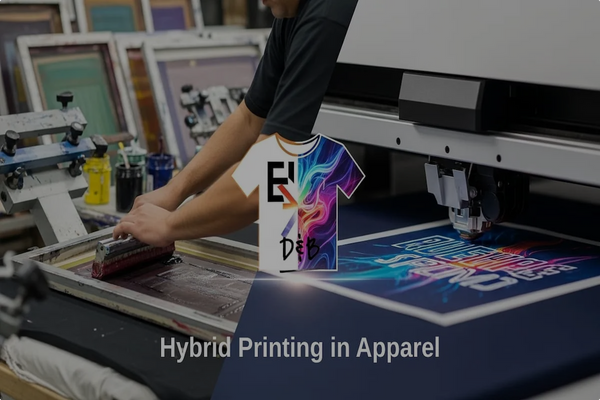
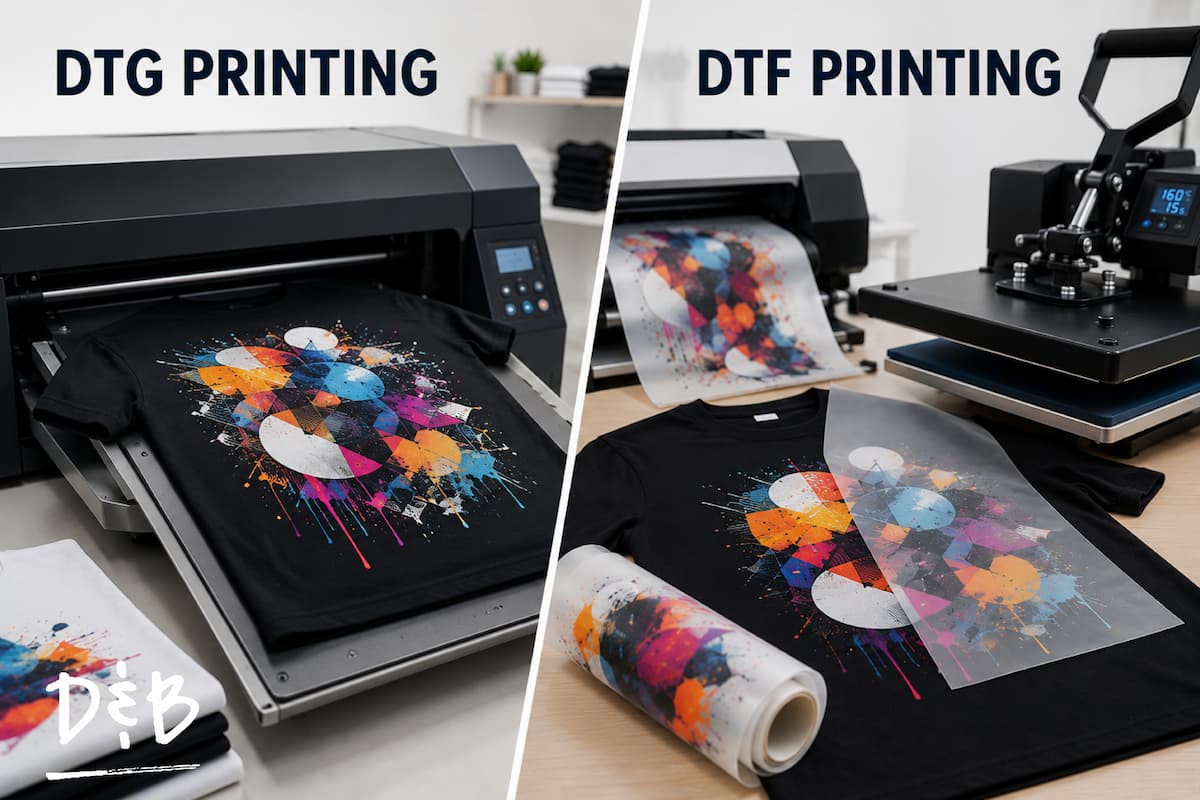
DTG sprays ink directly onto the garment for the softest hand feel and best photographic detail, but it's limited to cotton and requires pretreatment on dark fabrics. DTF prints onto film and heat-presses onto almost any fabric in any color, with stronger opacity and durability, at the cost of a slightly raised feel.
For most small- to mid-sized apparel businesses that print mixed fabrics and colors without minimums, DTF is the more flexible and forgiving choice. DTG wins when you're on premium 100% cotton and softness is the whole point.
DTG vs DTF: the short answer
Choose DTG if you print mostly on 100% cotton, sell on softness and photo-real detail, and want the print to feel like part of the shirt.
Choose DTF if you print on cotton, polyester, and blends, and on dark garments; run small-to-medium mixed orders; and want no pretreatment, no minimums, and transfers you can store and press on demand.
Neither is universally "better." They solve different problems, and plenty of shops run both. The rest of this guide explains the tradeoffs that actually decide it.
What is DTG printing?
Direct-to-Garment (DTG) printing works like an inkjet printer for fabric. Water-based ink is sprayed directly onto the garment and heat-cured. Dark garments are pretreated first, so the white ink underbase sits on top of the fibers instead of soaking in.
DTG excels at photographic detail, smooth gradients, and short runs on cotton. Because the ink soaks into the fabric, the print has almost no hand-feel; you feel the shirt, not the design. The tradeoffs are speed (each garment is pretreated and printed individually) and fabric range (the inks bond best to natural fibers).
One thing most comparison articles skip: DTG's reputation for inconsistency is largely a pretreatment problem, not a limitation of the method. Too little pretreatment and the ink sinks and looks weak; too much and it fails to bite the fabric and washes out. When a shop dials pretreatment in correctly, DTG can rival a good screen print. When it doesn't, results look mediocre, which is why fast, high-volume DTG operations sometimes disappoint.
What is DTF printing?
Direct-to-Film (DTF) printing transfers a design onto fabric using a film and an adhesive powder. A printer lays down CMYK ink plus a white underbase onto PET film, coats the wet ink with hot-melt TPU adhesive powder, cures it, and produces a finished, storable transfer. You heat-press that transfer onto the garment and peel the film.
Because a cured print is glued to the fabric surface, DTF needs no pretreatment and works on cotton, polyester, blends, and nylon in any color. Transfers can be printed in batches, stored for months, and pressed on demand, thereby decoupling printing from garment finishing and making DTF unusually flexible for on-demand and mixed orders.
DTF sidesteps DTG's biggest headache. There is no pretreatment to get right, because the adhesive powder does the bonding job that pretreatment does for DTG.
For a full breakdown of the process, see our ''What Are DTF Transfers?'' guide.
DTG vs DTF: full comparison
|
Feature |
DTG printing |
DTF printing |
|
Process |
Ink sprayed directly on garment, then cured |
Ink printed on film, powdered, cured, heat-pressed |
|
Pretreatment |
Required for dark garments |
Not required |
|
Fabric range |
Best on 100% cotton and cotton-rich blends |
Cotton, polyester, blends, nylon — light or dark |
|
Dark garments |
Needs pretreatment + white underbase |
Handled by the white underbase, no pretreatment |
|
Hand-feel |
Soft; ink absorbs into fibers |
Slightly raised; print sits on the surface |
|
Detail & gradients |
Excellent, photo-realistic |
High resolution; very heavy gradients slightly less soft |
|
Color vibrancy |
Excellent on light cotton, muted on darks without good pretreat |
Bold, opaque, consistent on any color |
|
Durability |
Good; can fade after 30–40 washes if under-cured |
Very high; 100+ washes with proper application |
|
Speed / workflow |
Slower; each garment printed individually |
Faster for batches; transfers printed ahead and stored |
|
Minimums |
None |
None |
|
Print now, press later |
No |
Yes |
|
Best for |
Premium cotton, photo art, soft-feel apparel |
Mixed fabrics, dark garments, small-to-mid runs |
Which lasts longer, DTG or DTF?
DTF generally lasts longer. A properly applied DTF transfer is rated for 100+ washes and resists cracking and fading because the cured print bonds across the whole design area. DTG is durable when correctly pretreated and cured, but tends to fade sooner, often noticeably after 30–40 washes, and under-cured DTG is a common failure point.
The caveat in both directions is that durability is mostly determined at production, not by the method's ceiling. A perfectly cured DTG print on a quality shirt can outlast a badly cured DTF transfer. But holding production quality equal, DTF's surface bond is harder to kill in the wash.
Is DTG softer than DTF?
Yes. DTG is softer because the ink soaks into the fabric, leaving essentially no hand feel. DTF sits on top of the garment so that you can feel the design as a thin, slightly raised layer.
But "DTF feels like plastic" is a quality signal, not a fixed property. The stiff, patch-like feel people complain about usually comes from three controllable things:
- Low-quality transfers with cheap powder or film
- Heavy ink laydown or an unnecessarily thick white underbase
- A large solid-fill design; a 12-inch block of ink will always have more hand-feel than line art
Shops that switched to well-made DTF transfers frequently report that customers don't notice or mention the feel at all, and returns don't go up. The difference between "plasticky" DTF and soft, flexible DTF is production control, which is exactly why the supplier you choose matters more than the acronym.
Do customers actually prefer DTG or DTF?
Here's the uncomfortable truth working printers will tell you: when shown the same design printed both ways, many consumers pick the DTG version, but usually because the colors look brighter to them, not because they detect finer print quality. Most buyers don't notice whether a print is perfectly solid and even; they notice color and whether it feels like "a real shirt."
That cuts both ways. Some heavy t-shirt buyers specifically dislike the DTF surface feel and will only buy DTG. Others move a whole shop to DTF, hear no complaints, and see fewer returns. The lesson isn't that one wins; it's that the blank garment, the design style, and the transfer quality decide customer perception far more than the printing method's name. Invest in good garments and good transfers, and most of the "which is better" debate disappears.
DTG vs DTF vs Screen Printing
Since most people weighing DTG vs DTF are also considering screen printing, here's how all three sit:
|
DTG |
DTF |
Screen printing |
|
|
Best for |
Photo detail on cotton, short runs |
Mixed fabrics, dark garments, small-mid runs |
Simple designs, large runs |
|
Colors |
Unlimited, no added cost |
Unlimited, no added cost |
Each color = a screen = more cost |
|
Setup cost |
Low |
None |
High (screens per color) |
|
Economical at qty 1 |
Yes |
Yes |
No |
|
Economical at qty 500+ |
No |
Competitive |
Best |
|
Fabric |
Cotton / cotton-rich |
Almost anything |
Almost anything |
|
Hand-feel |
Softest |
Slightly raised |
Soft to heavy depending on ink |
|
Durability |
Good |
Very high |
Highest — often outlasts the shirt |
The practical split shops actually use: screen printing for big, simple runs; DTG for premium cotton and photo art; DTF for everything in between, mixed fabrics, mixed colors, small quantities, and fast turnaround with no minimums.
DTG vs DTF Cost
DTG and DTF both avoid the per-color setup fees that make screen printing expensive on small runs, so both are cost-effective for low quantities and one-offs.
The cost story differs by garment color and volume:
- DTG on light cotton is cheap per print; DTG on dark garments costs more because it requires pretreatment plus a white ink underbase.
- DTF cost is driven by film area and ink coverage. Gang sheets, nesting many designs onto one film sheet, drop the per-design cost sharply, because you pay for film space, not per design.
- Equipment: entry-level DTF setups generally cost less upfront than industrial DTG units, but running either one in-house means ink, maintenance, waste, software, and labor. For most small businesses, ordering transfers from a supplier beats buying a printer until volume is consistently high.
Note: exact per-print prices vary too much by region, garment, and coverage to quote reliably; anyone giving you one firm number is estimating. Ask a supplier for a quote on your actual artwork and fabric.
How Big is the Market? (2026 context)
Digital textile printing, the category that includes both DTG and DTF, continues to grow at double digits. One 2026 industry estimate put the global digital textile printing market at USD 5.71 billion in 2025, rising to USD 6.44 billion in 2026, a CAGR of about 13.6% through 2032. Estimates vary widely among research firms, but the direction is consistent: digital methods continue to take share from traditional printing because they enable short runs and fast turnaround without high setup costs.
For a small apparel business, the takeaway isn't the exact figure; it's that both DTG and DTF sit inside a fast-growing, on-demand-driven category that isn't going anywhere.
Which Should You Choose?
Decide on four questions, in this order:
- What fabric? Mostly 100% cotton → DTG is on the table. Polyester, blends, nylon, or a mix → DTF.
- What garment colors? Lots of darks → DTF avoids the pretreatment gamble. Mostly light cotton → either works.
- What order sizes? One-offs and small mixed runs → DTF's gang sheets and stored transfers shine. Premium cotton short runs where softness sells → DTG.
- In-house or outsource? Consistent high volume → consider buying equipment. Variable or early-stage → outsource transfers and keep your capacity on pressing and selling.
Many established shops run both DTG for high-end cotton art and DTF for volume, sportswear, dark garments, and hard-to-print fabrics. That's not indecision; it's using the right tool per job.
Is there a DTF supplier in Texas?
Yes. DAB DTF Transfer is a Direct-to-Film manufacturer in Richardson, TX, serving the Dallas–Fort Worth metroplex and shipping nationwide. We produce custom transfers and gang sheets in-house, printed, powdered, and cured at our facility, never outsourced, with:
- No minimums, order one transfer or fill a 200-inch gang sheet
- Same-day local pickup in Richardson and across DFW
- 100+ wash durability, with inks meeting OEKO-TEX® compliance and output tested to AATCC and ASTM standards
- Free US shipping over $35 to all 50 states
If you're a DFW print shop weighing DTG against DTF, the fastest way to assess DTF hand feel and color is to press one yourself. Order a free sample and test it on your own blanks.
Ready to Compare for Yourself?
The most reliable way to settle DTG vs DTF for your products is to press a real transfer on your real blanks. Order a free sample, build a gang sheet, or contact us with your fabric and design, and we'll honestly tell you whether DTF is the right call or your project is a better fit for something else.