TL;DR
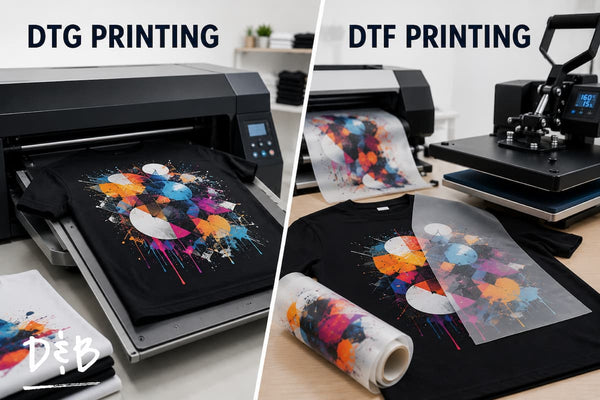
A DTF (Direct-to-Film) transfer is a full-color design printed onto PET film, coated with hot-melt adhesive powder, cured, and heat-pressed onto fabric. There is no weeding, no screens, no pretreatment, and no minimum order. It works on cotton, polyester, and blends in any garment color, which is why print shops use it for small and mid-size runs that screen printing can't price competitively.
What is a DTF transfer?
A DTF transfer is a ready-to-press design printed on a clear PET film using pigment inks and a white ink underbase, then coated with hot-melt adhesive powder and cured. You place it on a garment, press it with a heat press, peel the film, and the design stays on the fabric.
"DTF" stands for Direct to Film. The name describes where the ink goes first: onto film, not onto the shirt. That one difference is what makes the method so flexible. Because the transfer is finished and stable before it ever touches a garment, you can print today and press three months from now; printing and pressing are decoupled.
For a print shop, that means you can hold inventory of artwork instead of inventory of blanks.
How do DTF transfers work?
The production process runs in five stages. Stages 1 through 4 happen at the manufacturer. Stage 5 happens at your press.
- Artwork preparation. The design is prepared at 300 DPI with a transparent background and mirrored for printing. RIP software separates the color layers and generates the white underbase.
- Printing. CMYK pigment inks are printed onto the PET film, followed by a white ink layer on top. The white layer sits behind the design once pressed, which is what makes colors stay opaque on black and navy garments.
- Powdering. While the ink is still wet, thermoplastic polyurethane (TPU) hot-melt adhesive powder is applied. It bonds only to the printed ink, never to the blank film. This is why DTF has no weeding; there is no excess material to remove.
- Curing. The powdered film passes through a curing unit that melts the TPU into a continuous adhesive layer. Once cool, the transfer is dry, shelf-stable, and ready to ship.
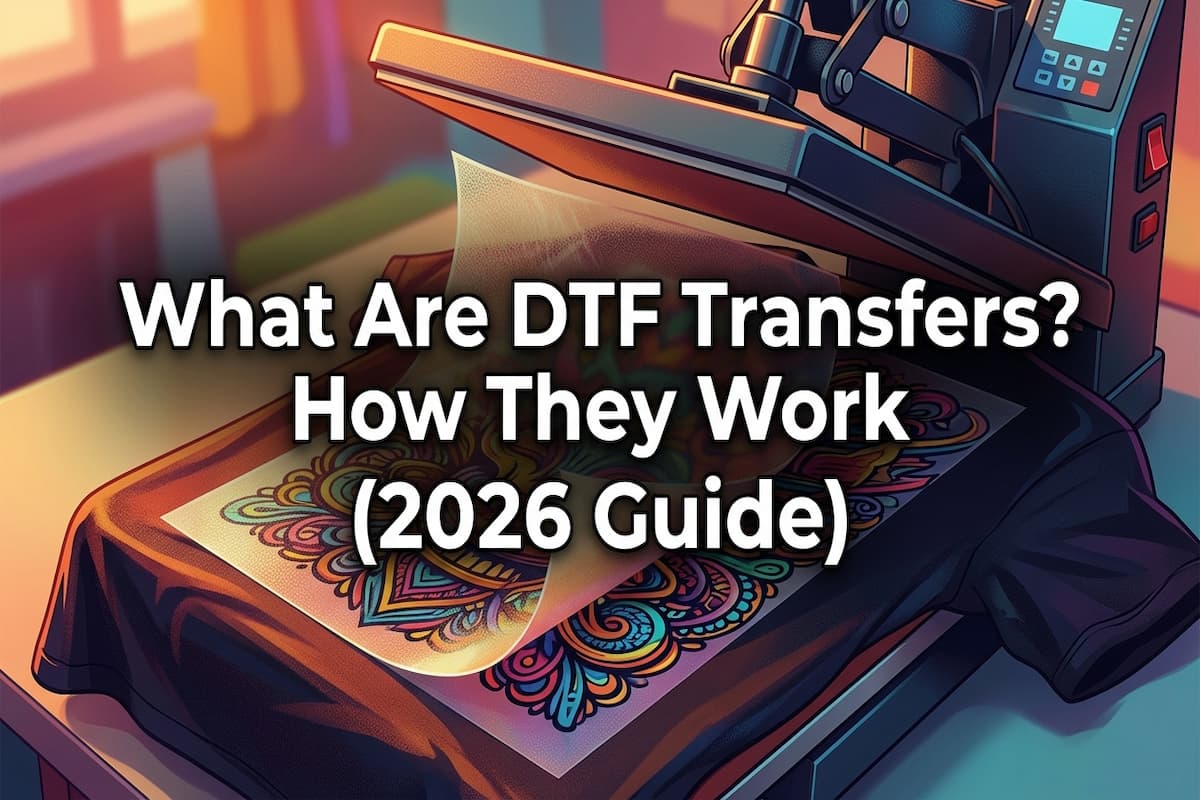
- Pressing. You position the transfer on the garment, press with heat and pressure, and peel the carrier film.
The TPU powder in stage 3 is doing most of the work people credit to the ink. It is the adhesive layer, the flex layer, and the reason a good DTF print stretches with a garment instead of cracking across it.
What materials are used in a DTF transfer?
| Component | What it does | Why it matters to you |
|---|---|---|
| PET carrier film | Holds the printed design until it's pressed | Determines hot peel vs. cold peel behavior |
| CMYK pigment inks | Produce the visible color | Ink quality drives color accuracy and wash fastness |
| White ink underbase | Blocks the garment color behind the design | Without it, prints on dark garments look washed out |
| TPU adhesive powder | Bonds the design to fabric | Controls stretch, hand-feel, and peel resistance |
| Curing heat | Fuses the powder into a solid layer | Under-curing is the #1 cause of transfers that lift after washing |
At DAB DTF, every one of these steps runs inside our Richardson, TX facility. Nothing is outsourced, and every batch is inspected before packing. Our inks meet OEKO-TEX® compliance, and our output is tested against AATCC wash fastness and ASTM color fastness standards.
How do you apply a DTF transfer?
Press at 315–325°F (157–163°C) for 15–20 seconds with medium-high pressure, then peel hot or cold depending on your film. Pre-press the garment first and post-press after peeling for the softest finish and best wash durability.
The full sequence:
- Pre-press the garment for 5–10 seconds. This removes moisture and wrinkles. Skipping it is the most common reason a transfer looks fine and then lifts after the first wash.
- Position the transfer ink side down.
- Press at 315–325°F for 15–20 seconds at medium-high pressure.
- Peel according to your film spec. Hot peel films come off immediately; cold peel films need to reach room temperature first. Peeling a cold-peel film hot will pull ink off the garment.
- Post-press for 5–10 seconds with parchment or a Teflon sheet over the design. This flattens the print, improves the hand-feel, and helps the adhesive seat into the fibers.
- Wait 24 hours before the first wash.
Do you need a heat press?
Yes, for anything you're selling. A heat press applies even pressure and holds a verified temperature across the whole platen. A household iron does neither; it has hot spots, no pressure control, and no reliable temperature readout. It can work for a one-off personal shirt. It cannot produce a consistent result across 40 school spirit tees.
Can you apply DTF transfers at home?
Yes. A DTF transfer requires no printer, no pretreatment machine, and no curing oven on your end; all of that happens before it ships. A heat press is the only equipment you need. That's precisely why DTF has become the standard entry point for Etsy sellers and side-business apparel brands: the production barrier is on the supplier's side, not yours.
DTF vs. screen printing vs. DTG vs. sublimation vs. HTV
| DTF transfer | Screen printing | DTG | Sublimation | HTV (vinyl) | |
|---|---|---|---|---|---|
| Works on dark garments | Yes | Yes | Yes (with pretreat) | No | Yes |
| Works on cotton | Yes | Yes | Yes | No | Yes |
| Works on polyester | Yes | Yes | Poorly | Yes | Yes |
| Full-color / photographic | Yes | Costly | Yes | Yes | No |
| Setup cost per job | None | High (screens per color) | Low | Low | None |
| Economical at qty. 1 | Yes | No | Yes | Yes | Yes |
| Economical at qty. 500+ | Competitive | Best | No | Situational | No |
| Weeding required | No | No | No | No | Yes |
| Pretreatment required | No | No | Yes | No | No |
| Print now, press later | Yes | No | No | No | Yes |
When to choose each
- Choose DTF for full-color designs, mixed-fabric orders, runs from 1 to a few hundred, or when you need to press on demand from stock artwork.
- Choose screen printing for large runs of simple, low-color-count designs. At 500+ pieces of a 1–2 color logo, screens still win on unit cost.
- Choose DTG for high-volume cotton-only work where you control the blanks and can absorb pretreatment time.
- Choose sublimation for 100% polyester in light colors, where you want the print to have no hand-feel at all because the dye becomes part of the fiber.
- Choose HTV for single-color text and numbers where you already own a cutter and the design is simple enough that weeding is fast.
The honest read: DTF didn't beat any of these outright. It removed the setup penalty that made small full-color runs unprofitable, which is the segment most shops actually live in.
How long do DTF transfers last?
A correctly applied, correctly cured DTF transfer should survive the useful life of the garment. Our transfers are designed to last 100+ washes with proper application, and are tested against AATCC wash fastness and ASTM color fastness standards.
Longevity depends on four things, roughly in order of impact:
- Cure quality at the manufacturer. Under-cured powder is the leading cause of transfers that peel at the edges after three or four washes. You cannot see this defect on arrival.
- Press accuracy. A press that reads 320°F but delivers 290°F at the corners will produce failures that look random.
- Fabric. High-poly performance fabrics and waterproof shells hold adhesive differently than cotton jersey.
- Care. Wash inside out in cold water, skip bleach and fabric softener, and tumble dry low or hang dry.
Does DTF last longer than vinyl or sublimation?
Versus HTV: generally yes. HTV sits on the fabric as a cut sheet of material and tends to lift at the edges. DTF bonds across the whole printed area with no cut edge.
Versus sublimation: no, and no method will. Sublimation dye chemically bonds inside polyester fibers, so there's nothing on the surface to crack or peel. The trade-off is that it only works on light-colored polyester. DTF trades some of that permanence for the ability to print anything on anything.
Why do some DTF prints feel like plastic?
This is the most common complaint about DTF, and it's a fair one. A DTF print that feels stiff or plastic-like is almost always the result of one of four things:
- Excess adhesive powder. Too much TPU creates a thick, rigid layer. Proper powder application coats the ink without building up.
- A heavy or unnecessary white underbase. A full-opacity white layer under a design going onto a white shirt adds thickness for no benefit. Good production adjusts the underbase to the garment.
- Large solid-fill designs. A 12" solid block of ink will always have more hand-feel than line art or a distressed design. This is physics, not a defect, but it's why experienced shops design for DTF rather than dropping a solid rectangle onto film.
- No post-press. Skipping the second press leaves the print sitting on top of the fibers instead of settled into them.
If you've received transfers from multiple suppliers and noticed some feel noticeably heavier than others, that difference is production control, not the DTF method itself.
What fabrics work with DTF transfers?
DTF transfers bond to cotton, polyester, cotton-poly blends, tri-blends, canvas, denim, and most fleece, in any garment color, light or dark. That covers t-shirts, hoodies, jerseys, performance wear, aprons, tote bags, and caps.
Fabrics that need testing before a production run:
- Waterproof or DWR-coated shells (the coating resists adhesive)
- High-stretch spandex-heavy performance fabrics
- Anything with a heavy nap or pile, like sherpa
- Heat-sensitive synthetics that can scorch below 315°F
Can DTF transfers be applied to wood, metal, or glass?
Not standard DTF. Those hard surfaces require UV DTF, which uses UV-curable inks and a different adhesive system, and is designed for tumblers, phone cases, glass, and wood. Standard DTF is a fabric process. Any guide telling you to press regular DTF onto a mug is giving you the wrong product.
What is a gang sheet, and when does it save money?
A gang sheet is a single large film sheet with multiple designs nested onto it. You pay for the film area you use, not per design, so filling the empty space costs you nothing extra.
This is where DTF pricing quietly separates itself from everything else. A shop running twelve different logos across eight schools can put all of them on one sheet, press each as needed, and never pay a per-design setup fee. Our gang sheets run up to 200 inches in length, and we produce up to 200 gang sheets or 1,000+ individual transfers per day.
Gang sheets make sense when you have:
- Multiple designs going to different customers in the same week
- One design in several sizes (youth, adult, left-chest, full-back)
- Ongoing stock artwork you press on demand
- A mixed order, team names, numbers, and a shared logo
Individual ready-to-press transfers make more sense for one-off orders or when you want a specific size without laying out a sheet.
→ Build a Gang Sheet or Upload a Ready File
Should you order transfers or buy a DTF printer?
Buying a DTF printer makes sense at consistently high volume with staff to run it. Below that threshold, ordering transfers is usually cheaper per shirt once you count everything a printer actually costs.
The equipment price is the visible cost. The ones that surprise people:
- Ink and maintenance. White ink settles and must be circulated. Idle printers clog. Printheads are consumable.
- Powder, film, and waste. Failed prints cost material and time.
- RIP software and color management. Getting a red to stay red across fabric types is a skill, not a setting.
- Ventilation and space. Curing units produce fumes and need dedicated square footage.
- Labor. Someone has to run, clean, and troubleshoot the machine instead of pressing garments and selling.
- Downtime risk. When your printer goes down mid-order, you have no supplier to fall back on.
The realistic question isn't "can I afford a printer" but "do I have enough consistent volume to keep one running daily, and is printing the part of this business I want to be in?"
Most shops that scale successfully answer that by outsourcing production and keeping their capacity focused on pressing, selling, and fulfilling.
Is DTF a trend or is it here to stay?
DTF isn't a trend; it filled a gap that existed for decades. Small full-color runs were always in demand; screen printing just couldn't price them, and vinyl couldn't produce them. DTF made that segment profitable, which is why adoption came from working shops rather than from marketing.
Direct-to-film began seeing real uptake in the early 2020s among small and mid-size providers, followed by dedicated DTF equipment from major manufacturers. Equipment vendors don't build product lines for fads.
What will keep changing is the quality floor: better powders with softer hand-feel, wide
How DAB DTF produces transfers
We are a manufacturer, not a broker. Your transfers are printed, powdered, and cured inside our facility at 1400 S Sherman St, Ste 114, Richardson, TX 75081, never outsourced, never drop-shipped from someone else's plant.
| Daily capacity | 40,000–50,000 inches of DTF film |
| Output | Up to 200 gang sheets (200 inches each) or 1,000+ individual transfers per day |
| Standards | OEKO-TEX® ink compliance, AATCC wash fastness, ASTM color fastness |
| Durability | Designed for 100+ washes with proper application |
| Minimum order | None |
| Shipping | Free US shipping over $35; nationwide to all 50 states |
| Local | Same-day pickup in Richardson, TX and the DFW metroplex |
Every batch is inspected before packing. When your business depends on the same red showing up in March and in September, that consistency is the product.
→ Order a free sample and judge the hand-feel and color yourself before you commit to a run.